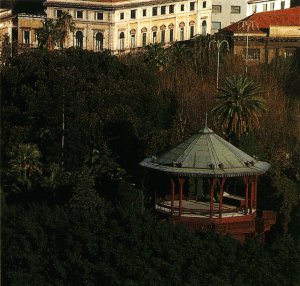
For the Catanese Bellini Gardens are quite simply “a villa”, a place of leisure, relaxation, strolls and meetings. It occupies in its entirety a surface of 70,942 sq. m. where flower-beds, open spaces for musical and sports events, benches to rest or read on, shades alleys and fountains find their setting.
Part of the space today included in the villa, formed the old Labyrinth, picturesque garden which surrounded a building erected during the eighteenth century by Ignazio Paternò Castello, prince of Biscari.
The habit to build gardens with intricate paths where guests could easily lose themselves was very fashionable in eighteenth century in Europe, as rationality and fantasy fused together and cohabitated, a taste for “wonders” and scientific rigour.
Around mid nineteenth century the municipality bought the family, in order to build a public park. In the following years new grounds were acquired to offer even more space and to allow the population of Catania to enjoy a large green area, very rich in floral decorations, palms, centenary trees and fountains.
Among the pages of a short but essential guide to the town, published in 1899, we find a typical description of the garden that from its inauguration was considered to be one of the most attractive in Europe.
“The Bellini Gardens – we read in the guide – is the most agreeable and charming rendezvous in town. Its position in enchanting.
From two small hills rising in the centre that are separated by a wide open space, one commands a large part of the city, the expanse of the sea and the majestic show f Etna.
For this diversity of the panoramic views they offer, the Gardens of Catania are considered to be one of the best in Europe.
One who looks from one of the two little hills, enjoys the same feeling as one who would look at Rome from the Pincio esplanade or at Florence from the piazzale Michelangelo.
The avenues of this garden are diverse and winding, thickly shaded they run along both the hillside and the flat parts of the villa.
Various truly elegant small bridges, the underpasses, a tunnel, the flower beds, the lawns garnished with all sorts of flower, the fountains, the esplanade dividing the twin hills, everything fuses together in order to transform this wondrous garden in a place of delight.
In summer one enjoys cool afternoon, shaded by the tall trees: wonderful sunsets for the warm oriental vividness of their reflection; and the evenings are spent delightfully as swarms of ladies populate the richly and fantastically illuminated villa”.
These words can still today, be considered appropriate; the atmosphere in the villa Bellini is the same which spurred the enthusiasm of our guide writer. In 1932 the old entrance on via Etnea was made monumental; also in that year the bridge roadpass was built over via St.Euplio and a circular pond was built for beautiful white swans to dwell in.
In 1933 the artist M.M. Lazzaro placed the statues representing the arts in the main entrance square. In recent years the Villa Bellini has welcomed prestigious shows to enliven the evenings of the Catanese people and of the Italian and foreign visitors.