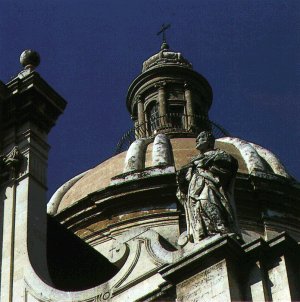
The regular Minorite priests came to Catania in 1625 thanks to the protection of the Senate and the engagement of the bishop Innocenzo Massimo.
In 1628 they moved to the church of S. Michele building a house, which, together with the hardly started church, was destroyed in 1693.
In 1630 Giambattista Paternò, an aristocratic of the town (who was later buried in the church) bequeathed the priests with much of his fortune.
The church follows the pattern of the basilica with three naves divided by pillars, the flat prospect and the vault built from 1771 to 1787.
The façade is of very white limestone and today, after a recent cleaning, creates a magnificent contrast with the black colour of the street and pavement.As you enter you will meet a double staircase with 13 steps in marble; in the inside of the church one can admire two holy water springs resting on marble tables, exceptional works because of the technical skill and the armony of composition. Among the praiseworthy art works we want to point out: an altar-piece dating back to the late 14th century representing S. Francesco Caracciolo, l’Arcangelo Michele his figure being covered by an embossed silver plate, a marble Crocifisso (late 18th century) and an Annunciazione by Guglielmo Borremans.
On the burial monument of G. Battista Paternò with his portray one reads: “To Giovanni Battista, nobleman of Catania, well-deserving patron of this church, the Minorite father priests bear witness of their grateful thinking”. In the presbyterial area the monumental organ decorated with golden embellishments.
A Flemish painter in Sicily: Guglielmo Borremans
The presence of a painting by Guglielmo Borremans in the church of the Minorites l’Annunciazione, allows us to talk briefly about this prolific painter of Flemish origin.
He was born in Anversa in 1672; little is known about his youth and his pictorial experiences, but it can surely be asserted that the artist lived in a very stimulating and creative environment, the same of Rubens, Van Dick and Jacob Jordaens.
Alike his masters he travelled around Italy, thought to be the cradle of the most important experiences of arts.
At the beginning he stopped at Naples where he came to known the works of Giordano and De Matteis.
Between 1714 and 1715, perhaps because he wanted to increase his working possibilities, he moved to Palermo, where he found a very fertile ground, ready to receive his very personal style, result of his fondamental Flemish training, enriched by the late experiences gained in Naples.
The fame of Borremans crossed the tight boundaries of Palermo and speard all over Sicily; the commissions arriving from all parts of the island witnessing the success of his art, rich in compositive and chromatic liveliness.
copyright Giuseppe Maimone Publisher