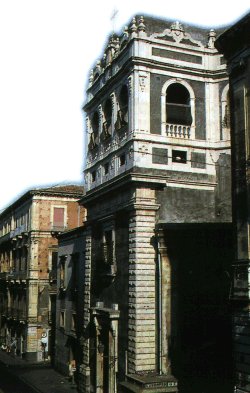
The church of Santa Chiara cover a whole block; the shortest side is enterly occupied by the church overlooking the lively Via Garibaldi (once Via S. Filippo) , where the S.Agata procession used to pass by.
The control of the scenic view of the procession has often determined the choice of particular solutions within the same pattern.Example of such solutions are the two viewpoint loggias built in the domes of S. Giuliano church in Via Crociferi, and St. Chiara. From this loggia it was possible to follow the entire procession of the saint, from the Cathedral on along Via Garibaldi. The monastery, built in the area behind the church, nowadays houses local administration offices. The design of the church façade is by S. Palazzotto ( in the mid of 1700). Inside, preceded by a short flight of steps, a wooden panel showing scenes from the bible.Above the entrance a beautiful gold plated choir stall, with the picture of St. Chiara. Five are the altars: the one of Immacolata, of S. Lorenzo, the main altar richly decorated with statues representing St. Chiara and S. Francesco, St. Chiara altar and SS. Crocifisso altar with a precious relic shrine. The centre of the vault shows a big fresco representing The triumph of the Clarisse. It is a work by Olivio Sozzi dated 1766. among the most remarkable attractions of the church is the polychrome marble floor.
Nuns life in Catania
“ The religious life of Catania in the 1700’s overwhelmed, ruled, layed on the civilian one by the presence of priests, nuns and friars.For this it is correct to talk in terms of a plentiful legion Sestini calls it oversized- who had settled in the heart of the town in the shadow and under the protection of the old Norman Cathedral. Having a quick look at the topography of the rebuilt town, reveals how churches, monasteries and convents rise one next to the other, almost choking the civil building during the slow process of reconstruction.
Before the 1693 earthquake there were 14 monasteries in Catania, later reduced by the bishop Riggio to six: following the rule of St. Benedict those devoted to St. Placido, S. Giuliano, SS.Trinità, S. Benedetto and St. Agata. The sixth following the rule of S. Francesco was devoted to St. Chiara. Almost all the nuns of the six monasteries belonged to the aristocratic society or to the upper middle classes.At those times every noble family used to entrust the education of their daughters to the nuns; the girls remained in the monastery until they took the veil sacrificing themselves in favour of the elder sister, sole heiress of the family’s fortune.Sometimes however it could happen that a daughter would rouse trying to regain her freedom."
( Gulielmo Policastro, Catania nel Settecento, 1950)
copyright Giuseppe Maimone Publisher