Reading the Urban Fabric
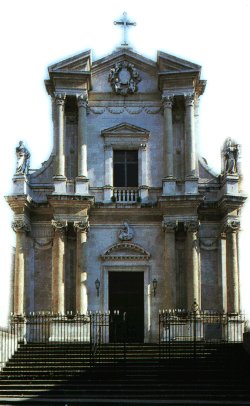
The beautiful Santa Maria dell’Aiuto church with its majestic limestone façade looks over the small piazza of the same name that opens out at the end of Via San Giovanni. In front of it is an elevated churchyard enclosed within an iron railing. Alongside the church the profile of a small chapel can just be seen, which contains a replica of the Sacred House of Loreto, dealt with in its own leaflet. Before considering the architectural features of the church we will mention briefly its location in an urban context that is not immediately and easily understood. This religious building is set in a block that is part of the San Cristoforo neighborhood, one of Catania’s most colourful. For some years this area has been inserted into the city’s artistic itineraries because it includes a considerable number of monuments that warrant a visit. The block in which the Santa Maria dell’Aiuto church stands was, prior to the 1669 eruption, on the upper part of a tract of the sixteenth-century wall and extend onto the territory of the plane whose richness and fertility were legend. Indeed, it was from these cultivated lands that the Catanese population managed to draw sustenance and wealth. The eruption destroyed them and the surrounding cultivated areas in the course of a few days and thus the city was deprived of those lands that constituted one of its main sources of well-being. In the sacristy of the cathedral in Catania there is a fresco that narrates the tragic moments of the 1669 eruption.
The Precious Icon of Maria
The miraculous image of the Madonna housed in the Santa Maria church in Via Pozzo Mulino was venerated from 1635 onwards. In order to provided it with a better location, it was placed in Santissimi Pietro e Paolo church which, from then on, changed its name to Santa Maria dell’Aiuto. Following the 1693 earthquake the building was reconstructed, the current façade is by A. Battaglia. The church houses precious work of art and artistic craftsmanship, and among these the Crucifix altar stands out with its precious reliquary that has 24 shrines. The splendid main altar in marble merits particular mention at its centre is an image of Mary mounted in a precious frame.
A feeling description of the altar comes from Salvatore Lo Presti, who wrote in the Popolo di Sicilia (1943): “The main altar is a sweet symphony of coloured marble group in marble symbolizing the Eternal Father sitting above the clouds and surrounded by five angels, one of which, on his left, support a large globe; at the two extremities, at the height of the ciborium, it is adorned with two medium-sized statues which represent Saint Peter and saint Paul respectively”.
copyright Giuseppe Maimone Publisher