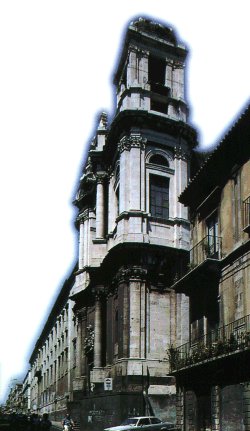
The church of the Holy Trinity (1746-1751). Next to the monastery (now housing a scientific high school), the church of the Holy Trinity was built in the present site ( Via V. Emanuele) after the 1693earthquake. The design of the façade, concave in the central part, is attributed to Francesco Battaglia; on the front door, preceded by a lava stone staircase stand two engraved figures turning their eyes over to the bright eye of God placed in the center. The wide surface of the façade is stirred bt the columns together with the three large windows in the second order. High above two small quadrangular towers rets, closed by the domes. Due to the leveling of the roadway in the second half of 1800, entrance portal and the central hall has been joined to the atrium by a double flight of stairs. The side entrance on Via Quartarone has been closed because the level of the street is much lower than the one of the building. The inside of the church has an elliptical shape, while the presbiterial area has a rectangular plan, this was intended to provide a harmonious space effect to the whole. Above the entrance is the elegant choir stall, finely decorated.
The works and their authors: Sebastiano Conca and Olivio Sozzi
Within the Trinity church, some works of artistic importance can be seen; over the first alter on the right the Battesimo di Gesù ( Baptism of Jesus) by Olivio Sozzi, over the third altar the large painting figuring the Madonna appearing to St. John the Baptist on Patmos island. This work is signed and dated “made by the knight Conca in 1756”. On the left side over the first and third altar are: Crocifissione (Crucifixion) and the La Trinità appare a S.Benedetto ( Trinity appearing to S. Benedict) a painting signed and dated 1756 by Olivio Sozzi. Sebastiano Conca ( 1680-1764) was a painter from Latium and reached a widespread reputation in Sicily. Citti Siracusano ( La pittura del Settecento in Sicilia, 1986 ) writers:” the activity of this painter, whom we can define ‘deux ex machina’ in the Sicilian pictorial scene, because of his intriguing and persisting presence till the early 800 is largely witnessed by a number of altar pieces, which though being part of his traditional and successful formula, not always can by ascribed to his refined and cultured production. This may perhaps be put in relationship with the Sicilian provincial taste of local aristocracy, not as much sophisticated as the Roman and Neapolitan ones.” Olivio Sozzi was born in Catania in 1690 and died ( perhaps falling down from a scaffolding) in 1765. He learned the drawing art in Palermo where he married a rich woman named Caterina Cappello. ( thanks to her dowry he was able to complete his pictorial studies). After 1729 he started his Roman stay attending Conca’s workshop. Sozzi remained in Rome several years getting a deeper knowledge of Roman classicism but above all he drew insipiration from the brilliant influence of Giaquinto to whom he was related by a cordial friendship. After Rome he reached Palermo where his elder son was born ( who was to follow his father’s steps). From the second half of the XVIII cent. until his death Sozzi decided to settle back in Catania, his home town.
copyright Giuseppe Maimone Publisher