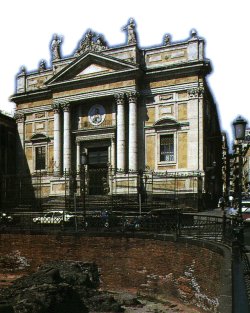
The church of St. Biagio is located in Piazza Stesicoro right in front of the large trench with the ruins of the Roman amphitheatre. The white façade, preceded by a flight of steps, is of the late 1700. The origin of this church dates back to 1098. after the earthquake of 1693 it was rebuilt under the will of the bishop Andrea Riggio who incorporated to it the church named after. The same bishop founded there in 1710 the congregation of the secular priests under the title of “ our Lady of Seven sorrows”. In memory of such episode a large medallion was engraved, figuring the Mother of Sorrows , by Salvatore Calì, which commands the center of the white façade. In the inside can be seen : a painting figuring S.Giovanni Nepomuceno, on the first altar and a painting showing Il Martirio di San Biagio ( the martyrdom of S.Biagio) on the second altar ( right side).
The presbytery contain two chapels, one dedicated to the Crucifix (left) and one to St. Agata. In this chapel it is worshiped a precious relic which the tradition associates to the martyrdom of the saint patrones of Catania, the socalled “furnace” of St. Agata, from which the church derived its popular denomination of “la carcarella”.
The “furnace” is protected by a glass; a latin inscriptions recalls one of the most dramatic times in Agata’s life, the torture of the red-hot coals; we read: “Here she was swept away by the red-hot coals”
According to the tradition, the saint sustained and surmounted this terrific torment, and from that time on, by analogy, she was elected the savior from the fire of eruption. For those who live at the foot of Etna it is important to believe in a miracle able to halt the fire streams running over the houses and the fields; in this regand, through the centuries, a bond has been Strengthened between St. Agata and the salvation from the fire; for the people of Catania the most powerful relic is the “Veil of St. Agata”, which the year after her death ( 252) was carried in a solemn procession next to the lava front threatening the city.
The veil, is said, changed its colour from white to red: it is evident the symbolic value of this latter colour which became eventually an active counterpart of the red fire of Etna. Beside the chapel of the “furnace”, the major altar, and the one dedicated to the Sacred Family can be seen together with the other altar with the martyrdom of St. Andrea.
The offering of the wax candles
The 3rd. of February at noon, the inauguration day of the celebrations to St. Agata, a solemn procession moves from the church of St. Biagio, with the bishops and members of the City Council, to ward the Cathedral where the wax candles will be offered to the Saint.
To get Piazza Stesicoro and to the church of St. Biagio, the major and the authorities use the traditional “Senate coach” made by gold-plated painted wood, of the late XVIII cent. And a second coach less decorated. The coaches used for the procession are kept in the City Hall at the Cathedral square.
The train winds along via Etna, preceded by valets wearing XVIII cent. Costumes, playing trumpets and drums and carrying the wax and flowers.
copyright Giuseppe Maimone Publisher