In the most fascinating street of the 18th century
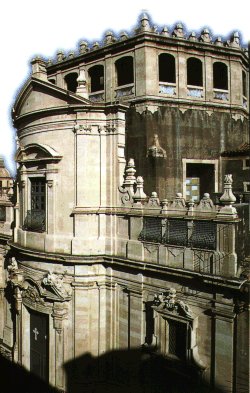
The church of S. Giuliano is inserted in a suggestive urban context overlooking Via Crociferi, the most fascinating street of the 18th century. Right in front of the church is the large complex of the Jesuits consisting of the church dedicated to S. Francesco Borgia and the large college next to it (today the seat of the arts school) which encloses four courtyards. According to some scholars the church of S. Giuliano was built by Vaccarini between 1739 and 1751. The concave prospect is stirred and crowded by a loggia placed at the second order of the façade.Over the broken up tympanon, crowning the entrance, two allegoric female figures.
The short churchyard, enclosed by a railing, is decorated with a texture of both black and white stones.
High above, the dome is wrapped by a polygonal gallery recalling of S. Chiara.From this gallery the nuns – usually coming from the aristocracy – used to follow the procession during the celebrations held in honour of S. Agata on the fifth of February; watching the train, first along Via S. Giuliano then turning into Via Crociferi.
The internal, wrapped in a suggestive golden light, is a large octagonal space with the chapels and the altars displayed alongside. The most remarkable works are the main altar, a Crucifix of the 14th century, the Madonna delle Grazie and S. Giuseppe and S. Benedetto by Olivio Sozzi and S. Antonio Abate of the XVII century.
Next to the church the convent, today the seat of the trade-unions.
Nun’s life in Catania
“Before the 1693 earthquake the monasteries in Catania were 14, later the bishop Riggio reduced them to 6, under the rule of S. Benedict those dedicated to S. Placido, S. Giuliano, SS. Trinità, S. Benedetto and St. Agata, the sixth one, following the seraphic rule of S. Francesco, was dedicated to S. Chiara.
Almost all the nuns of the 6 monasteries belonged to the aristocracy or to the upper middle class. Noble families at that time used to entrust the education of their daughters to the nuns, girl often stayed and eventually took the veil sacrificing themselves in favor of the first born brother or else in favor of the elder sister, the sole heiress of the family’s fortune.
After a year of novitiate the girl was consecrated to Christ, wearing the monastic robes, then had to prostrate herself in the chapel, covered with a black pall, two branched candlesticks burning on each side, while the bells rang as for funeral, everybody experienced deep emotions. Once the ceremony was over, the girl got up, the sacrifice was accomplished.
A special treatment was then offered by the abbess to relatives and guests” (Guglielmo Policastro, Catania nel Settecento, 1950).
Bibliography
S. Boscarino, Sicilia Barocca. Architettura e città, 1610-1760, Roma 1981.
G. Dato, La città di Catania. Forma e struttura, 1693-1833, Roma 1983.
AA.VV., Enciclopedia di Catania, Catania 1987 -Guida di Catania e provincia, a c. di N. Recupero, Catania 1991.
copyright Giuseppe Maimone Publisher