A space for welcoming visitors
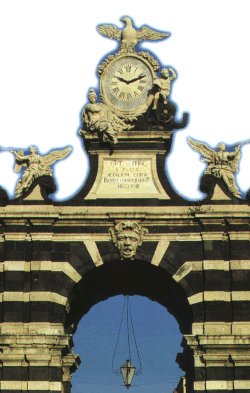
Looking at it today Piazza Palestro appears as one of the many, happy and worrying contradictions of the Catanese urban fabric: at its centre, like the immense spectacular stage set of a 1700s theatre, is the Garibaldi Gate, loaded with bombastic symbols and allegories, precious pomp and heroic quotations, while all around is a rosary of old houses, high and low, of modern builings, of roads and shops.The open space here, originally, presented itself as a spectacular embrace directed towards the country and the visitors who
came from Palermo and the Plain of Catania preparing to enter the city. The house were simple, without architectural pretensions and were also used as workshops.In this space the ritual moment and daily life were woven and are still woven together in a powerful and dissonant harmony.To borrow the words of G. Dato, we could say, then, that the system of Catanese squares is not only the site of exclusive rituals of the dominant class or the occasional site of markets, but it is an ingenious “machine” with the function of mediating natural needs and different purposes, from honouring the sovereigns to the normal occupations linked to the world of agricultural work and commercial trade.
The buildings arranged along the long sides present the piers of the doors and the corner pilasters decorated with the same motif of alternating bands of white and black stone which Ittar had used for the Ferdinandea Gate.
The great triumphal Gate
The Porta Garibaldi, once Ferdinandea, many be put forward as an example of that style built through sculptural effects, significant flashes of light and shadow, contrasts in colour and, together, different materials arranged in an order optical alchemy of great emotive power. To the structural and material play there must be added the psychological and symbolic one linked, for ever, to the idea of the “gate” ( here more precisely a triumphal arch) which lives its own life, united from a dyke, a dividing wall or a border. This monument was realized, based on drawings by Stefano Ittar, in 1768 as a celebration of the marriage of Ferdinand IV of Bourbon with Caroline of Austria. Up on high, in the gable that today carries a clock, there was a large medallion with portraits of the two sovereigns. Out of hatred for the Bourbons part of the dedicatory inscription was barbarously destroyed. With the end of Bourbon domination the gate’s name changed too, from Ferdinandea to Garibaldi, but the Catanese know it as “Fortino”, in an erroneous association with the fort of Duke of Ligne, a gate of which exists near Via Sacchero, within the same neighbourhood. Standing in front of the gate and looking towards Via Garibaldi one can see, far off and harmonius, the cathedral dedicated to Saint Agatha; thus the gate closed an architectural discourse that begins in Piazza Duomo. Via Garibaldi provides the setting for the square gem of Piazza Mazzini and then continues, after a long, straight run, into the traffic and the anonymity of the modern city.
copyright Giuseppe Maimone Publisher