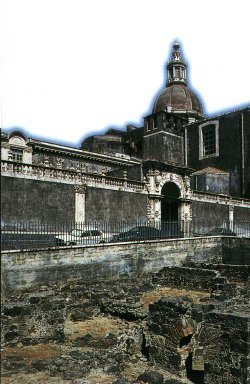
Piazza Dante
This large piazza is dominated by the immense mass of the (incomplete) church of San Nicola and the buildings of the Benedictine monastery complex hidden by a high perimeter wall.
In 1774-’76 work was carried out on the problem of the monumental arrangement of this piazza. The Benedicitines wanted this work to be done and were encouraged by the Catanese who were proud to have a monastery on their territory that was so magnificient it was considered as a kingdom. This was the first invention aimed at recovery, rationalisation and embellishment of the late 1700s city. As Salvatore Boscarino wrote in Sicilia Barocca (1981), this was not simply to beautify the great monastery complex, whose image had been spoiled by the miserable appearance of the poor and humble housing and by the solitude that was only interrupted by the appearance of the poor beggars asking for food and shelter, but it was also to create a space that akllowed the people to take part in the solemn and sumptuous religious celebrations that took place there. The most important problem to be faced was that of demolishing the miserable sheds that had accumulated round the monastery and which impeded the view of the façade of the church and the enormous monastery complex created following decaded of hard and extremely expensive work. It was perhaps the architect Ittar who designed the crescent that closes the piazza with its three symmetrical buildings that functioned to create a correspondence with the façade of the church of San Nicola. Today there is a movement attempting to return the piazza to the city. The problem of poor quality buildings, ofetn uninhabited, still persists and indeed a new plan for the recovery of the neighbourhood and all of the city’s historical centre could start here.
Catania’s Baths and its Acropolis
In front of the Benedictine Monastery are the remains of a Roman thermae complex which testify to the wealth of this area in which many archaeological remains, mosaics and significant tracts of ancient buildings dressed in marble and refined decoration have been found. On entering the interior of the monastery complex the visitor can see the trenches from the recent archaeological excavation that has brought to light interesting fragments of the history of ancient Catania.
The excavation is on what the summit of the acropolis hill (the high part of the ancient city) where, thanks to an uninterrupted digging campaign begun in 1978 (led by the Institute of Archaeology of the University of Catania), the following features have been found: significant traces of prehistoric life on the site (Neolithic and Copper Age); Greek material dating to the seventh century B.C.; fragments of built up areas of roman Catania and the historical phases that preceded the seismic catastophe of 1693.
According to ancient sources (Thucydides) Katane (Catania) was founded in 729 B.C. by the same Chalcidinians who had come from Eubea and had founded Naxos. The choice of the site was probably determined by the presence of fertile land and water. Indeed, it is not by chance that the city’s coins carried a symbol of the Amenano river (today partly visible in Piazza Duomo at the foot of the fountain of the same name), represented as a bull with a man’s face and, later, as a young man with small horns on his forehead.
copyright Giuseppe Maimone Publisher