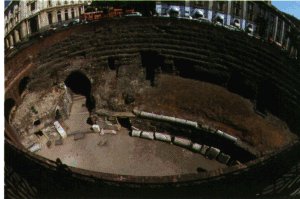
At the centre of Piazza Stesicoro there is a large trench that encloses some remains of Catania’s Roman amphitheatre. Photographs from the end of the nineteenth century show that the piazza was completely covered by some ornamental flower beds.
The work carried out in uncovering the amphitheatre (already known to experts in Catanese history) was begun in m1904 at the request of Mayor De Felice, who entrusted the initiative to the architect Filadelfo Fichera, and it was completed in 1906. The work was officially inaugurated six months later and in 1907 it was visited by King Vittorio Emanuele III who came to Catania to inaugurate the Agricultural Show.
This grandiose Roman monument, one of the largest in Italy, is almost entirely hidden under modern constructions, but it is visible below road level where there is the corridor that runs round the wall of the podium. The construction extends and involves many of the roads that run off Piazza Stesicoro. Some portions of the raised part of the construction can be seen in two side roads of Via Manzoni (one of these has the atmospheric name, Via del Colosseo).
From building point of view the amphitheatre consists of a cavea, an auditorium of 14 terraces divide into three orders with a podium and ambulatories (covered corridors) giving access to the terraces arranged on three levels that corresponded to the two orders of the external arches and the attic.
The external circumference is 309 metres, the circumference of the arena 192 metres and it has been calculated that it could contain 15,000 seated spectators and almost double that figure with the addition of structures for standing spectators.
As with many other Roman monuments, lava together with cement mortar and brick was used as the main building material; in the small portion of the arena that is accessible some decorative fragments have been found and preserved.
Dating of the building is still uncertain and is based on study and recognition of construction techniques. Along these lines archaeologists have formulated the hypothesis that the amphitheatre in Catania may date to the mid second century B.C.
In Theodoric’s times the monument was already in an advanced state of abandonment. Roger the Norman used its imposing structure by stripping it of masonry necessary for building the cathedral. Today these blocks can be seen in the external construction of the cathedral apses, accessible from Via Vittorio Emanuele 159.
The Amphitheatre in the Roman World
The amphitheatre is a monument that constitutes a fusion of grandiosity of dimensions and elegance and musical rhythm of superimposed arches, marked by the richness of its ornamental elements. On the whole Roman architects succeeded in obtaining a balanced solemnity modulated by proportions that are never exaggerated neither horizontally nor vertically.
The vast construction, ellipsoidal in shape, is made up of various orders of terraces that rotate around a central space (from which the name amphitheatre – theatre [with seats] around) where games and shows of various kinds took place.
Among the most popular were fights between gladiators, fights between men and wild beasts and naval battles when, thanks to complex hydraulic mechanism, the arena could be transformed into a large pool full of water.
copyright Giuseppe Maimone Publisher