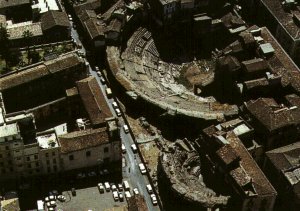
A complex Urban Fabrica
Catania’s Odeum, together with the large theatre, forms part of great richness and complexity. Urban growth following the 1693 earthquake was regulated by the city Senate which dedicated to organize the areas available (for reconstruction) by dividing the city along a conventional line: to the east (Piazza Duomo and Via Vittorio Emanuele) the value of the land was higher, while to the west (beyond Via Plebiscito and in the area of the ancient acropolis) Iti was clearly lower. In the eastern, most prestigious part, the opening up of main roads (today know as via Etnea, via Vittorio Emanuele, via Garibaldi) meant that the areas already destined for use by the wealthy nobility and ecclesiastical orders were further enhanced. Throughout the eighteenth century and during the first half of the nineteenth many noble and bourgeois residences were built here, together with the main civil, administrative and religious buildings. To the west instead there was a concentration of poorer residential building that developed around what was left of the medieval town , without taking into account the planning rules laid down by the Duke of Camastra. The 1700s also sow the construction in this area of buildings destined for social welfare activity-hospitals, hospices, jails, schools. Within this tight knit of blocks, roads and alleys are some of ancient Catania’s most significant monuments: the Roman Theatre and the Odeum, the baths in Piazza Dante (in front of the monumental entrance of the Benedictine monastery complex), remains of the Norman fortifications (in the grounds of the Liceo Spedalieri), 1500s bastions known as the Bastione “degli infetti”, of the infected, and two Aragonese reinforcement towers (the one known as “del Vescovo”[ the Bishops’s] is visible at the height of Via Plebiscito).
Within the intricate mixture of old and modern buildings, these remains of the past take shape as you penetrate into the maze of little street and courtyards.
The Roman Odeum
The Odeum (small building for musical and dance performances) sits to the west of the large theatre. It is also suffocated by the high buildings that completely invade the stage area and today are used to support the painted backdrop that is set up for the summer musical programme. This combination of theatre and odeum is found in other Greek and Roman cities; the main difference between the two structures is that the odeum had a roof covering.
The orientation of the small construction corresponds to that of the theatre, that is in the direction of today’s Via Vittorio Emanuele. There is however a notable difference in level in that the odeum is at the height of the highest part of the theatre-the summit of the Montevergine hill that constituted Catania’s acropolis.
The semicircle of the odeum is formed by 18 walls that become progressively wider so as to form long and narrow wedges inside which 17 rooms were created with vaulted roofs. The function of this rooms, restored in the 1960s, is not yet clear .
Construction material for most of the building was lava stone. The orchestra (the semicircular space between the cavea[auditorium] and the stage area) is paved in marble, which is still visible. As in the theatre bricks and marble were used in contrast with the back lava which granted the building the polychrome quality that is typical of Catania’s monuments.
copyright Giuseppe Maimone Publisher