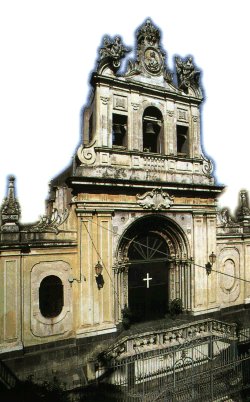
The entrance to the eighteenth-century Church of S. Agata al Carcere (Saint Agatha at the Prison) graced with a splendid decorated portal, one of the most interesting works of Catanese medieval architecture.
Sources state that this portal was originally the main entrance to the ancient cathedral, destroyed in the 1693 earthquake; in 1734 it was removed by the architect Vaccarini and transported to the Senate Palace.
Later (circa 1760) it was donated to the city government by the Sacred Prison Confraternity which, in those years, was at work enlarging the churches.
The stylistic features of the portal are such that it can be held to be unique in Sicily because (apart from a few details in the decoration of the small columns) it bears no similarity with the portals of Arab-Norman churches.
The pilaster in the side panels are decorated with plant volutes that are tangled with human and fantasy figures. The six small columns are decorated with chessboard and herringbone motifs.
The capitals carry sculpted leaves, in some cases alternating with small heads in ape-like poses.
Above the capital are some sculptures of human and zoomorphic figures (animals on their haunches, a man sitting, an ape with its elbow on its knee and a ball in its mouth and so on).
The best view of the “Church of the Sacred Prison” is that offered from Via del Colosseo. Like a theatrical set, the church sits on high, preceded by a wide flight of steps and with the medieval portal much in evidence. In the eighteenth-century arrangement the church was built on a corner of the sixteenth-century bastion which envelops an old area that religious tradition has identified as being Saint Agatha’s prison.
The church houses two relics that are extremely important to the cult of the Catanese saint: a chest in which the sacred remains were carried during their difficult journey from Constantinople to Catania and two lava slabs with the marks of the saint’s little feet which tradition explains in the words of the inscription at the entrance to the prison: “ Here, having been pushed by the quick fury of her persecutor, she stood while she was about to fall into the cavern of her prison”.
Inside what the Catanese identify as being the site of the saint’s imprisonment, there is a small altar with a marble statue of Agatha recalls her miraculous recovery worked by Saint Peter (her breasts had been torn from her chest). Tradition again has it that the martyr’s death took place here, represented by a simulacrum under the altar.
Inside the single-naved church there is a canvas on the main altar depicting the Martitio di Sant’Agata signed “Bernardino Niger grecus” (1588); this work is particularly interesting because the painter chose to reproduce Catania’s ancient amphitheatre which can be seen clearly behind the saint and her persecutors.
Bibliography
AA.VV., Quaderno 16. Dipartimento di Architettura e Urbanistica, Catania 1992.
Guida di Catania e provincia, a c. di N. Recupero, Catania 1991.
copyright Giuseppe Maimone Publisher