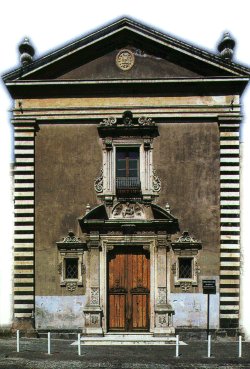
In Santa Maria di Gesù square almost hidden to the view a little Church, whose façade dates to 1706 has been attributed to Girolamo Palazzotto.
Next to it is the XVIth century Paternò Family Chapel, whose front is decorated with bicrome fascias, alternating black and white stones. The access to the building is through a beautiful portal engraved in 1519 by Antonello Gagini. It is surmounted by a “lunette” figuring the Virgin with the Child.
The chirch, a property of the Paternò Carcaci family, was erected in the XVth century and partly rehandled by Antonello Gagini in 1518. Later it was rebuilt in 1693 after the earthquake. At the present the small sacred buildings is absorbed by the enormous blocks of modern buildings extending all around the square dominated by the huge foliage of a centenarian Ficus.
Particularly chasing is the contrast between the preciousness of the mansions in floral style adorning the Viale Regina Margherita and the architectural essentiality of the façade of the little church. During the post-unitarian years, when the acquisition or sometimes the splitting up of the sacred buildings occurred, the church and the annexed monastery were used, first as the seat of a charitable institution, and later incorporated to the technical school “Archimede” (looking on Viale Regina Margherita) to whom the XVIIIth century cloister supplied the premises for the machine workshop.
The play of black and white
On the façade of the church the black (lava stone) and white (lime stone) decorations stand out, common matter in the construction of 1400. (The balcony of the Palazzo Platamone in Via Landolina just to mention one).
The same decorations can be seen in the structures of the Paternò Chapel (spared by the 1693 earthquake), on the left of the prospect, with a large window, where the play of the chromic alternation produces the effect of a plastic relief.
You enter the church through a portal surmounted as mentioned before by a little “lunette” with a delicate and tender picture of the Virgin with the Child. Inside a large wooden Crucifix by fra Umile da Petralia (who died in 1639) can be admired, on an altar is placed the beautiful Virgin with the Child, a marble work by Antonello Gagini. To the church of S. Maria di Gesù used to belong a famous polyptych with the Virgin on the throne Child, S. Francesco, S. Antonio and the Resurrection dated 1497; this work is by Antonello de Saliba (1466-1535) and his school. Nowadays it is possible to see this polyptych, now split up, in the first hall of the museum of the Ursino Castle (Piazza Federico II).
The Paternò Chapel
The Paternò Chapel is situated on the left side of the church entrance; you enter it through a marble portal surmounted by a “lunetta” figuring La pieta by Antonello Gagini (1519). An inscription informs that the building was commissioned by Alvaro of the Paternò Family who still alive wished to build this chapel being concerned about his death. The date is 1519.
In the chapel there is also an altar with a Virgin in Glory by Antonello Gagini (1525). Within the construction are placed several funeral monuments with epigraphs and inscriptions.
Bibliography
S. Boscarino, Sicilia Barocca. Architettura e città, 1610-1760, Roma 1981.
G. Dato, La città di Catania. Forma e struttura, 1693-1833, Roma 1983.
AA.VV., Enciclopedia di Catania, Catania 1987.
Guida di Catania e provincia, a c. di N. Recupero, Catania 1991.
copyright Giuseppe Maimone Publisher