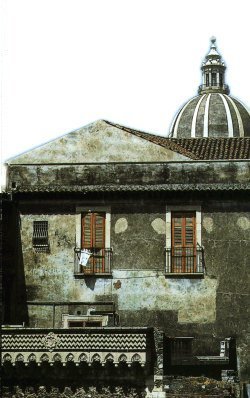
In Via Landolina number 11, you enter the court yard of the former convent S. Placido through a large entrance. The monastery covers a trapezoidal shaped block of house; the short side is occupied by the façade of the church and only partly by the building which instead extends along the major prospects. S. Placido church that named the little opposite square is one of the Baroque jewels of Catania; the façade ( 1769) is by Stefano Ittar, who succeded in creating a play of concave lines present also in the bright internal.Inside the monastery some wall structures used to belong to the old palace of the Platamone family “alla marina”.The Platamone and Biscari family were granted the privilege to open a “posterna” ( small opening in the city wall) to ensure a direct access to the port.Platamone house were incorporated in the monastery in the XVth century because the family had donated them to the monks. When the convent collapsed during the 1693 earthquake it was reconstructed absorbing the pre-existing structures.What remains today of the original XVth century building is the large portico surmounted by a balcony banister (XVth century ) decorated with a chevron motif, that means a two coloured fascia ( lime and lava stone). In the center within a “mixtilinear” framework the family coat of arm stands out. An extraordinary freshness and compositive elegance feature the gothic arches resting on limestone corbels, where decorations with floral and vegetal motifs are engraved alternating to human figures.Islamic heritage and the gusto of “bicromia” decorations “ Starting from the Norman age, alongside with its structural use, lava stone becomes the basic element in the area expressing the “gusto” of the two-coloured decorations of Islamic origin featuring the Mediterranean architecture with a wide use of it at least all over the Eastern part of Sicily. But due to the later seismic destructions now it is more present on the Northern slopes of Mount Etna. The tendency to use inlay work was mainly developed in Catania from where it spread over to Messina and Syracuse. Yet, due to the reconstruction of the town in the 18th century only few elements were left to witness this use, such as the pediment of the balcony of the Platamone palace, which certainly was the prototype of similar and later pediments like the one of Palazzo Migliaccio in Syracuse”. ( Claudia Guastella in La pietra di fuoco, 1994).
The Palace of the Culture : a space for the community
Lately the city administration of Catania has turned the space of the former convent of S. Placido back to the local community. Besides the destination of this site for cultural meetings and music events this facility was meant to gather and host the members of the several ethnical communities, who live and act in Catania.
Consequently a “ Casa dei Popoli” ( house of nations) has been created, whose aim is to make the local community acquainted with the variety and richness of the extra-European cultures.
copyright Giuseppe Maimone Publisher