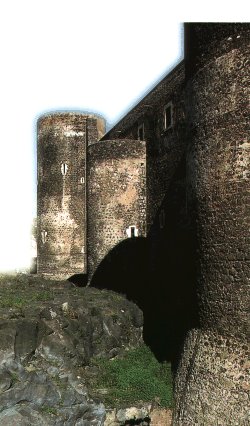
The Ursino Castle (the origin of the name is still uncertain) is located at the centre of the large square dedicated to Friederich II of Schwaben. The history of the construction is associated to the “praepositus edificiorum” Riccardo da Lentini; to his regard is known the content of a letter in which the Emperor inquires about the site where the castle was to be raised. Initially the castle was standing next to the sea and was surrounded by a ditch and by defensive works.
Lately a sequence of explorations has been carried on, which will allow to expand the knowledge of all the stages of the constructions.
According to Augusta G. Manuele (who has accurately studied the monument) “the castle was completed in a short time in order to prevent the citizens of Catania from revolting.
“Recent excavations have brought to light a particular construction technique consisting of a first external wall curtain made by square lava stones properly displayed, followed by a second internal curtain of a less accurate consistency together with the wall joining both, poor in quality as well. This difference in the manufacturing process finds, therefore, its justification in the urgency Friederich II had to complete the work”.
The present aspect of the castle is radically different from the original one; the external part of the building being altered by the lava flow of 1669 which covered several districts of Catania and a consistent portion of the surrounding territory.
The tragic event is witnessed by a fresco in the sacristy of the Cathedral; in which the castle can be seen with its ancient defensive works.
During 1400 the castle hosted the Aragonese royal family members, later it became a garrison’s headquarter and prison (the courtyard still preserves the prisoners “graffiti”).
During this century, in the thirties, the building was restored, to this time dates the construction of the staircase inside the courtyard together with the pseudo-ditch on the outside.
The inner square courtyard, gathers columns and sarcophagi with obelisques and architectural fragments coming from the monuments of the ancient city.
The best preserved façade is the one on the north, in which are clearly visible the sign left by the Hebrew workers as well as the Christian and Arab labour, each marking the progress of the daily commitment a particular symbol borrowed from their religious faith.
Outside, on the east side, over a large window, stands out a five pointed star made with both white and black stone, which has a cabalist meaning.
Lava: from destruction to construction
“In the constrictive recovery efforts of the Normans and Schwabian times, lava stone turns back in evidence again, sometimes in profiles neatly outlined, elsewhere accurately compounded in the structure of the walls, as in the castles of Adrano, Paternò, Motta S. Anastasia and the Ursino Castle, where the use of lava stone features the subsequent restructuring and minor episodes, subject to the inspiration of the labour, who could draw religious symbols on the surface of the walls by spotting the mortar with lavic pebbles.” /Claudia Guastella in La pietra di fuoco, 1994).
Bibliography
G. Dato, La città di Catania. Forma e struttura, 1693.1833, Roma 1983.
AA.VV., Enciclopedia di Catania, Catania 1987.
Guida di Catania e provincia, a c. di N. Recupero, Catania 1991.
copyright Giuseppe Maimone Publisher